Microphones
🎯 Learning Objectives
By the end of this topic, you should be able to:
- Understand the basic working principle of microphones as transducers converting acoustic energy into electrical signals.
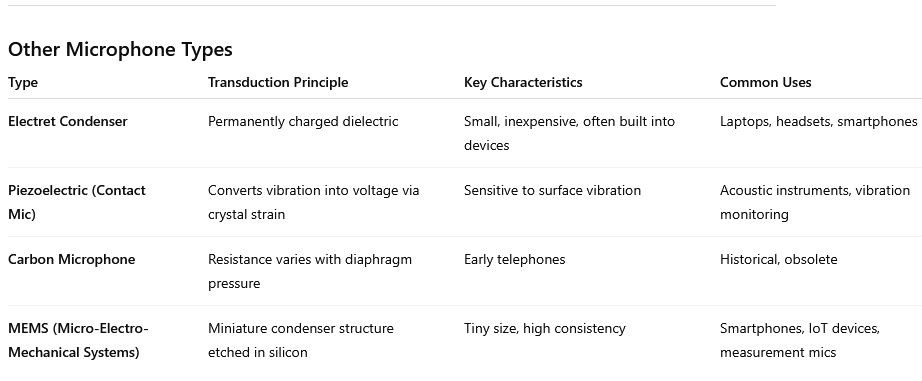
- Identify and describe the main types of microphones: dynamic, condenser, ribbon, electret, piezoelectric, carbon, and MEMS.
- Explain how polar (directional) patterns define a microphone’s sensitivity to sound from various angles.
- Compare omnidirectional, cardioid, supercardioid, bidirectional (figure-8), and shotgun patterns and their practical applications.
- Evaluate microphone selection for different use cases (e.g., studio vocals, live performance, measurement, field recording).
Introduction:
A microphone is a transducer that converts sound pressure variations in air into a corresponding electrical signal. Microphones are essential components in audio recording, telecommunication, broadcasting, speech recognition, and sound measurement systems.
At its core, every microphone performs the same fundamental function:
Convert acoustic energy (sound waves) → electrical energy (voltage).

How Microphones Work:
Sound waves are pressure variations in the air. When these waves strike a diaphragm (a thin membrane), it vibrates. The way this vibration is converted into an electrical signal depends on the microphone principle, i.e., the physical transduction mechanism.
Moving-Coil (Dynamic) Microphone
Working principle: Electromagnetic induction
A lightweight coil of wire is attached to a diaphragm placed in a magnetic field. When the diaphragm moves (due to sound), the coil moves relative to the magnet, inducing a voltage proportional to the air pressure change.
Features:
- Rugged, durable, inexpensive
- Handles high sound pressure levels (SPL)
- Moderate frequency response
Typical uses: Studio recording, acoustic instruments, ambient pickup
Examples: Neumann U87, AKG C414
Ribbon Microphone:
- Working principle: Electromagnetic induction (like dynamic)
- A very thin corrugated aluminum ribbon is suspended in a magnetic field. Sound waves cause the ribbon to move, generating a voltage.
- Ribbon mics are velocity microphones, responding to particle velocity rather than pressure.
- Features:
- Smooth, natural sound
- Bidirectional (figure-8) pickup pattern
- Fragile and sensitive to wind or phantom power (in passive types)
- Typical uses: Vocals, brass, room ambience
- Examples: Royer R-121, AEA R84
Microphones Directivity and Types:
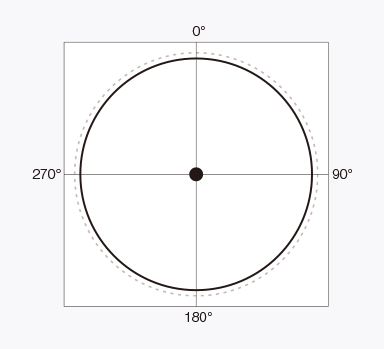
🎙️ 1. Omnidirectional
Pattern shape: A perfect circle - equal sensitivity in all directions.
Description:
An omnidirectional microphone picks up sound equally from 360° around the capsule. There is no front or back; all angles are treated the same.
How it works:
Pressure-sensitive diaphragm responds to changes in sound pressure, not pressure gradient. Since only one side of the diaphragm is exposed, sound direction doesn’t affect response.
Pros:
- Very natural sound — captures full ambience.
- No proximity effect (no bass boost when close).
- Ideal for measurement, choir, or room ambience recordings.
Cons:
- Poor isolation — captures unwanted sounds from all directions.
- Not suitable for noisy environments.
Common uses: 🎧 Room recordings, field recordings, acoustic measurement mics, lavaliers (lapel mics).
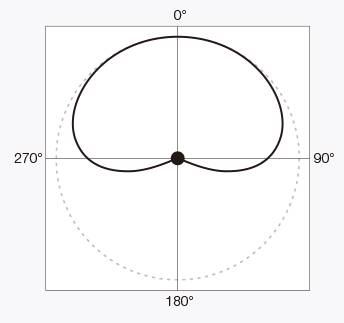
🎤 2. Cardioid
Pattern shape: ❤️ (Heart-shaped) - maximum sensitivity at the front, minimal at the rear.
Description:
- A cardioid microphone is most sensitive to sound coming from the front (0°) and rejects sound from the rear (180°).
- It’s the most common directional pattern for studio and live use.
How it works:
Combines both pressure and pressure-gradient elements to cancel sounds arriving from behind.
Pros:
- Good front isolation from background noise.
- Natural sound capture with limited ambience.
- Moderate proximity effect (bass boost when close).
Cons:
- Rear rejection not perfect — off-axis coloration may occur.
- Must be aimed properly toward the sound source.
Common uses:
- 🎙️ Vocal microphones, podcasting, instrument recording.
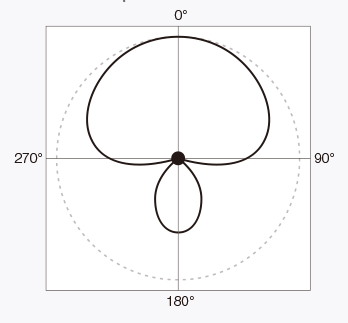
🎙️ 3. Supercardioid
Pattern shape: 💧 Slightly narrower than cardioid, with a small lobe of sensitivity at the rear (~120°).
Description:
A supercardioid mic is more directional than cardioid, focusing tightly on the front source but still slightly sensitive to sounds from behind.
How it works:
Has a higher proportion of pressure-gradient operation — increasing front directionality but introducing a small rear pickup zone.
Pros:
- Excellent front focus — better rejection of side noise.
- Common in film and broadcast where background rejection is key.
Cons:
- Small rear pickup — must control reflections from behind.
- More pronounced proximity effect.
Common uses:
🎬 Film booms, stage vocals, live sound reinforcement.
🎧 4. Hypercardioid
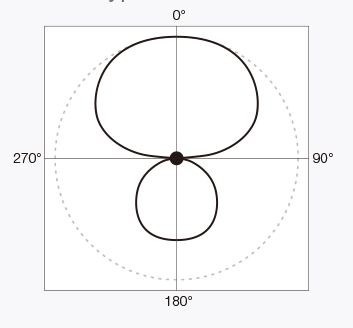
Pattern shape: 🎯 Even narrower front pickup than supercardioid; larger rear lobe.
Description:
A hypercardioid microphone provides very strong directionality, excellent at isolating the desired source in noisy environments.
How it works: Even more pressure-gradient component than supercardioid — creates deep nulls around 110° and 250°, and a strong back lobe around 180°.
Pros:
- Best isolation from side noise.
- Useful in reverberant or live environments.
Cons:
- Picks up more from directly behind.
- Very sensitive to mic placement.
Common uses:
🎥 Boom mics, dialog capture, broadcast headsets.
🎚️ 5. Bidirectional (Figure-8):
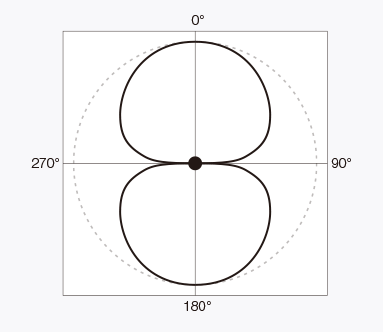
Pattern shape: ∞ (Figure-eight) - equal pickup from front and back, none from sides.
Description:
A bidirectional microphone captures equally from 0° (front) and 180° (rear) but rejects 90° (sides).
This is the natural pattern of ribbon microphones and some dual-diaphragm condensers.
How it works:*
Pure pressure-gradient mic — both sides of diaphragm are exposed equally to sound pressure.
Pros:
- Excellent side rejection.
- Natural for stereo techniques (Mid–Side, Blumlein pair).
Cons:
- Captures both front and rear — needs acoustic control.
- Strong proximity effect.
Common uses:
🎙️ Studio vocals (figure-8 ribbons), MS stereo recording, two-person interviews (opposite sides).
Microphone Sensitivity:
One of the most common questions people ask is: "What does "Microphone Sensitivity" really mean?"
Microphone sensitivity refers to how well a microphone picks up sound. In simpler terms, it's a measure of how efficiently the microphone converts sound waves into electrical signals.
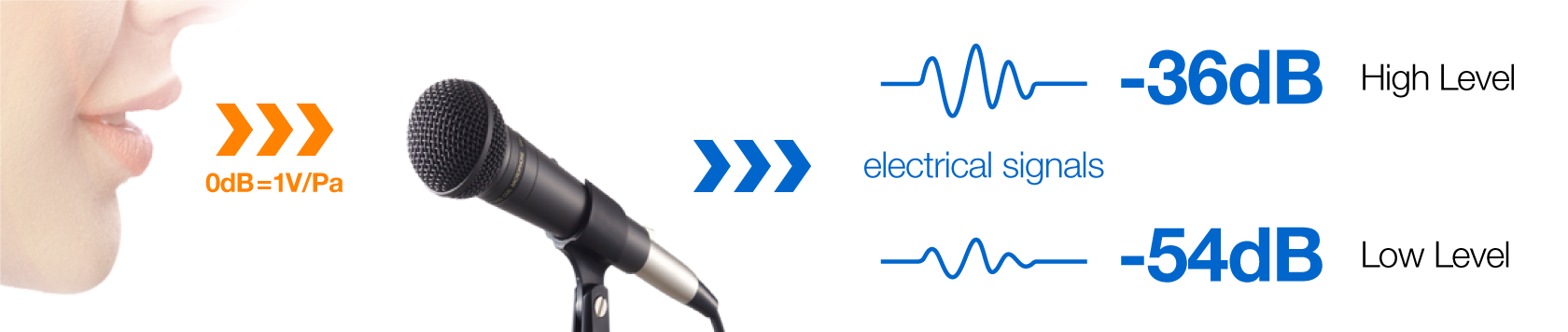
Question: Which microphone picks up quieter sounds better: one with "-54dB" or "-36dB" sensitivity?
Answer: The microphone with "-36dB" sensitivity is better for picking up quieter sounds.
Here's the catch: some people might think "-54dB" means it picks up much quieter sounds because the number is lower, but that's not quite right! Microphone sensitivity refers to how well a microphone picks up sound. In simpler terms, it's a measure of how efficiently the microphone converts sound waves into electrical signals.
There are two key things to remember about microphone sensitivity:
- Higher sensitivity means the microphone produces a stronger electrical signal for a given sound level. This can be helpful in quiet recording situations where you need to capture faint sounds.
- Microphone sensitivity is specified in various ways, with millivolts per pascal (mV/Pa) and decibels (dB) being the most common.
Here's a breakdown of how sensitivity affects microphones:
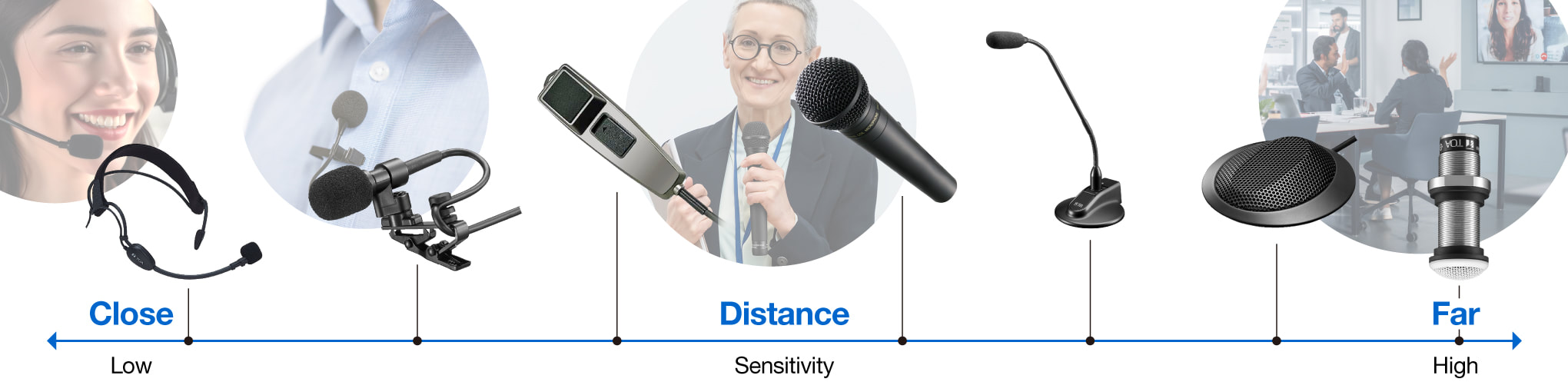
- High sensitivity mics: These pick up quieter sounds well but may also be more prone to picking up background noise. They might require less gain adjustment on the recording device.
- Low sensitivity mics: These need louder sounds to produce a strong signal and may not be ideal for quiet environments. They might require more gain to boost the signal.
How it is measured?
Microphone frequency response and polar patterns are two interrelated measurements used to characterize a microphone's performance. The frequency response refers to how sensitive a microphone is to different sound frequencies. It's typically measured in an anechoic chamber (an almost completely soundproof room) using a calibrated sound source like a loudspeaker. The source emits pure tones (sine waves) at various frequencies, and the microphone's output is measured at each frequency. The resulting data is plotted as a graph showing the microphone's sensitivity across the frequency spectrum.
In order to create a polar pattern, sound sources are positioned around the microphone at specific increments (usually every 15 or 30 degrees) and the frequency response is measured at each position.
🎨 Visual Demonstration
Enhanced Microphone Polar Patterns
Angle: 0.0°
Sensitivity: 1.00
The red dot represents a moving sound source. Trail shows its past positions — aligned with the microphone’s directional pattern.
🧠 Key Takeaways
- A microphone converts sound pressure variations into corresponding electrical signals — acting as a sound-to-voltage transducer.
- The transduction principle varies by type: dynamic (electromagnetic), condenser (electrostatic), ribbon (velocity), piezoelectric (crystal strain), or MEMS (silicon microstructure).
- Polar patterns describe how sensitive a microphone is to sounds arriving from different directions.
- Omnidirectional mics capture equally from all directions, while cardioid and supercardioid focus on the front, rejecting noise from behind.
- Figure-8 (bidirectional) microphones capture equally from the front and back — ideal for stereo or mid-side recording.
- Shotgun microphones use interference tubes for extreme directionality, excellent for film and field recording.
- Proper microphone choice and placement significantly affect timbre, clarity, and background rejection in recordings.
🧠 Quick Quiz
1) What is the primary function of a microphone?
2) Which microphone type operates based on electromagnetic induction?
3) What is the main advantage of a condenser microphone?
4) Which polar pattern captures sound equally from all directions?
5) What is a common use case for a bidirectional (figure-8) microphone?