Spherical Harmonics
🎯 Learning Objectives
By the end of this topic, you should be able to:
- Describe and mathematically model monopole, dipole, and distributed sources.
- Derive the spherical wave solution of the acoustic wave equation.
- Understand volume velocity, sound power, and radiation impedance.
- Calculate directivity factors and far-field sound pressure levels.
- Apply these principles to practical sound source characterization and simulation.
Spherical Harmonics and Plane Waves:
Starting with the Laplace operator, we obtain a separable solution:
which leads to three differential equations including three constants , , and .
The solution for the azimuth angle is:
For the elevation angle , the orthonormal Legendre polynomials of degree and order complete the spatial angular solution:
with the standard Legendre polynomial
Thus, the angular part becomes the spherical harmonic:
Negative–order harmonics follow from:
Spherical harmonics serve as an orthonormal basis over the surface of the unit sphere.
Radial Solutions and Near-Field Behavior:
With near-field effects included, the radial equation becomes
Its solutions are spherical Hankel functions:
Thus the full spherical mode is:
Modes are orthogonal over the sphere:
Spherical harmonics can be used to decompose measured or simulated source directivities.
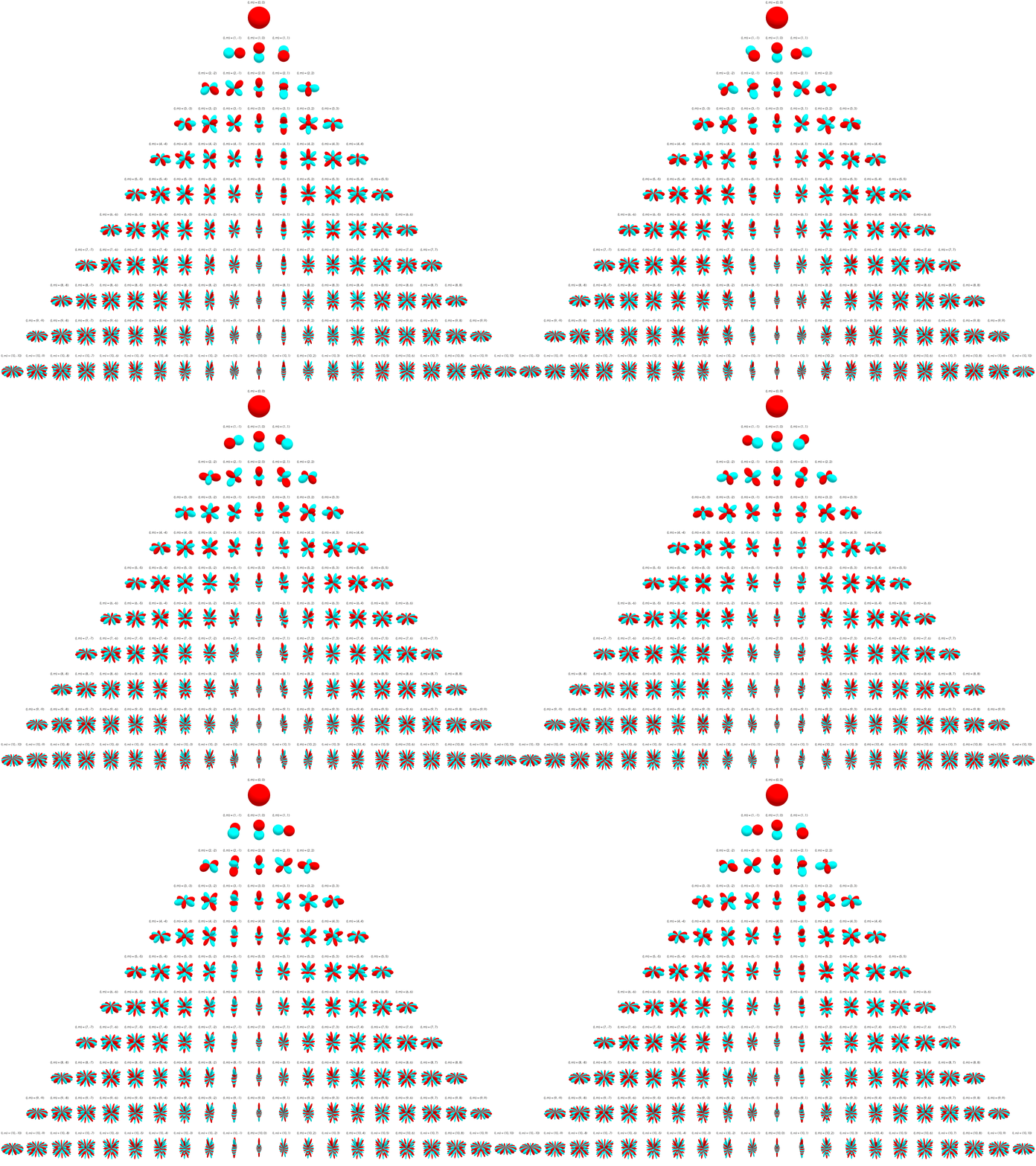
Figure. Dipole source radiation pattern.
Spherical Harmonics (SH) Transformation:
Any function can be expanded:
Coefficients are obtained via
This is analogous to Fourier series on a sphere.
If represents outgoing modes, the pressure field is
Plane Wave Representation with Spherical Harmonics:
A plane wave decomposes into spherical harmonics:
This relationship forms the theoretical foundation of Ambisonics and spatial audio rendering.
Multipole Synthesis:
Multipoles approximate source directivity by superposition of:
- Monopoles
- Dipoles
- Quadrupoles
- Higher-order poles
Differences:
- SH: centered at a single point, global basis
- Multipoles: spatially placed, often more efficient for non-spherical sources
- Multipoles converge faster when a source does not exhibit spherical symmetry.
🧪 Interactive Examples
Spherical Harmonic Visualizer
📝 Key Takeaways
- Spherical harmonics form an orthonormal basis on the sphere for directional acoustic fields.
- Directivities and radiation patterns can be encoded, analyzed, and reconstructed using SH coefficients.
- The radial dependence of modes is governed by spherical Hankel functions, capturing near- and far-field behavior.
- Plane waves can be expanded into SH, enabling sound field synthesis (e.g., higher-order Ambisonics).
- Multipole expansions offer an alternative to SH for modeling non-spherical or complex sources with fewer parameters.
🧠 Quick Quiz
1) Which function forms the angular basis for decomposing a directional acoustic field?
2) The radial dependence of a spherical wave is described by which functions?
3) A plane wave expansion in SH is essential for which technology?