Reverb Effects
🎯 Learning Objectives
By the end of this topic, you should be able to:
- Understand the principles of reverberation in audio.
- Identify key parameters: pre-delay, decay time, room size, damping, and wet/dry mix.
- Apply reverb effects to different audio sources effectively.
- Recognize different types of reverb algorithms and their usage.
Introduction:
Reverberation (reverb) is the persistence of sound after the source stops due to multiple reflections in an environment. It gives depth, space, and warmth to audio signals.
Example Analogy: Clap your hands in a small room versus a cathedral. The sound in the cathedral lingers much longer, creating a “tail” - this is reverberation.
Physical Principles of Reverberation:
Sound Reflection in Rooms
Sound waves bounce off surfaces. The pattern and decay depend on:
- Room size
- Shape
- Surface absorption
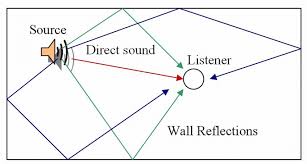
Early Reflections vs Late Reverb
- Early Reflections: Arrive within ~50 ms after direct sound, provide spatial cues.
- Late Reverb: Dense overlapping reflections that form a continuous decay, contributing to “ambience.”
Quantifying Reverberation
Reverberation Time (RT60)
Time for sound energy to decay by 60 dB.
Where:
- (V) = Room volume in cubic meters (m³)
- (A) = Total absorption in sabins, calculated as the sum of surface areas multiplied by their absorption coefficients:
- = Area of the i-th surface
- = Absorption coefficient of the i-th surface
Example:
A room: , walls absorb 20% (), floor 10% (), total area
sabins
sec
Types of reverb
The following table summarizes the main types of reverb, their descriptions, and characteristics:
| Type | Description | Characteristics |
|---|---|---|
| Natural | Real rooms, halls, churches | Authentic, depends on space |
| Plate | Vibrating metal plate | Smooth, dense reflections |
| Spring | Coiled spring vibration | Metallic, “boingy” |
| Digital Algorithm | Delay lines + filters | Flexible, programmable |
| Convolution | Convolve input with recorded IR | Realistic room sound |
📘 Explanation of Reverb Parameters:
Pre-Delay
The pre-delay is the time between the direct sound and the onset of the first reflections.
- Short pre-delay: small room effect.
- Long pre-delay: larger space impression.
Decay Time / RT60
Decay time determines how long it takes for the reverberation to die down by 60 dB.
- Short decay: tight, small spaces.
- Long decay: large halls, lush ambience.
Room Size
Defines the virtual size of the simulated space.
- Small: intimate, short reflections.
- Large: spacious, long reflections.
Damping
Controls the absorption of high frequencies.
- High damping: duller reverb (less bright).
- Low damping: brighter reverb, simulating reflective surfaces.
Wet/Dry Mix
- Dry: unprocessed original signal.
- Wet: processed reverberated signal.
- Balancing wet/dry controls how much effect is perceived.
🎨 Visual Demonstration
DAW-style Reverb Demo
Input Waveform
Wet Output Waveform
🎤 Applying Reverb to Specific Audio Sources
Vocals
- Moderate pre-delay (20–40 ms) for clarity.
- Decay time: 1–2 s depending on song style.
- Wet/dry mix: 15–30% for natural ambience.
Drums
- Shorter decay times for snare or kick to avoid mud.
- Longer decay on toms or room mics for depth.
- Wet/dry mix: 10–25% on overheads.
Guitar / Piano
- Use longer decay for spacious effect.
- Adjust damping to control brightness.
- Wet/dry: 20–40% depending on mix context.
🔁 Advanced Reverb Techniques
Algorithmic vs Convolution Reverb
- Algorithmic: uses delay networks to simulate space, CPU-efficient, flexible.
- Convolution: uses real-space impulse responses (IRs), realistic, fixed characteristics.
Early Reflections vs Late Reverb
- Early reflections: define spatial perception and size.
- Late reverb: defines tail and ambiance.
Parallel Reverb
- Mix multiple reverbs (short, medium, long) in parallel for rich depth.
🧠 Key Takeaways
- Reverb simulates the acoustic characteristics of physical spaces.
- Key parameters: pre-delay, decay time, room size, damping, wet/dry mix.
- Correct application enhances clarity, depth, and realism in mixes.
- Advanced techniques like convolution, parallel reverb, and tailored damping allow precise control.
🧠 Quick Quiz
1) What does pre-delay in reverb control?
2) Which parameter defines how quickly the reverb tail decays?
3) What is the difference between algorithmic and convolution reverb?
4) High damping in reverb affects which frequencies?
5) What wet/dry ratio is typically used for vocals to maintain clarity?