Introduction
🎯 Learning Objectives
By the end of this topic, you should be able to:
Furthermore, properties of the medium like inhomogenity of sound velocity and viscous effects can cause influences such as refraction and attenuation, respectively. Modeling of these phenomana is often a challenging task but nevertheless interesting, because many of the theoretical concepts involve approximations related to object dimensions in comparison with the acoustic wavelength.
For audible sound these span from metres to centimetres, so there is no general solution covering all frequencies in broadband sound. Any time a sound propagation model is discussed, it must be kept in mind its limited frequency range of validity. In this chapter the fundamental effects and their quantities of sound propasgation are introduced. Sound radiation from sources often occurs in free space. This applies to the sound that reaches the receiver directly over a free line-of-sight (obviously this applies usually to outdoor sound propagation or to sound propagation in close distance between source and receiver, so that no obstacle is in the propagation path). An important law of sound propagation describes the dependence of sound intensity and sound pressure level on the propagation distance.
The following table summarizes several basic distance laws
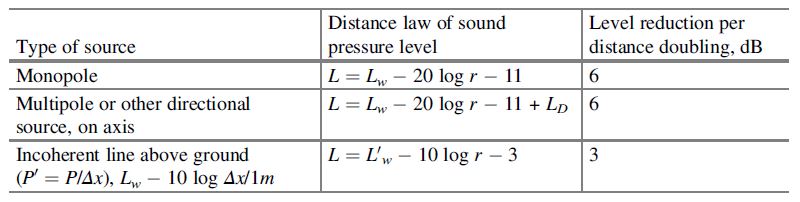
Figure 1. Free-field propagation from elementary sources in direction of maximum sound radiation
From here, we proceed by assuming a wave which has almost plane wavefronts, and in particular, the wave impedance is in very good approximation equal to the characteristic impedance of the medium, . This condition is generally justified in the far field, i.e. in a distance corresponding t .