Sound Sources
🎯 Learning Objectives
By the end of this topic, you should be able to:
- Describe and mathematically model monopole, dipole, and distributed sources.
- Derive the spherical wave solution of the acoustic wave equation.
- Understand volume velocity, sound power, and radiation impedance.
- Calculate directivity factors and far-field sound pressure levels.
- Apply these principles to practical sound source characterization and simulation.
In the chapter on fundamentals in acoustics and for the discussion of plane waves, we concentrated on the sound field at arbitrary observation points. At this point, sound sources were not yet taken into consideration. The characterization of sound sources, however, is one of the most important tasks in simulation and auralization. Solving the wave equation in polar coordinates is the first step to obtain a physical description of a source. The solution will lead to fundamental properties of spherical waves, to sound source directivities and to mathematical methods for acoustic signal processing of radiation problems.
Spherical Waves
A spherical wave models sound radiation from a point-like, omnidirectional source, also called a monopole.
- The source is assumed to be much smaller than the wavelength:
- The source injects a volume flow (volume velocity) into the medium:
This represents the rate at which the source moves air, and due to omnidirectionality:
- There is no angular dependence on or
- The pressure depends only on radius and time
Thus, the problem is spherically symmetric.
Reduction of the Wave Equation
In full 3-D, the Laplace operator is:
With spherical symmetry, all angular derivatives vanish:
The inhomogeneous acoustic wave equation becomes:
where:
- = sound pressure
- = speed of sound
- = air density
- = volume velocity of source
Solution Using d’Alembert Form
We assume a solution of the form:
Substituting reduces the equation to:
The d’Alembert solution gives:
Hence, the general solution for a spherical wave is:
This shows the pressure decays with distance as and propagates outward from the source.
The relation between and the source volume velocity is:
Note: The pressure at the observation point is proportional to the time derivative of the volume velocity.
This explains why small loudspeakers exhibit poor low-frequency output.
Harmonic Monopole Source and Sound Power
For a harmonic excitation:
The corresponding sound pressure:
The particle velocity:
The wave impedance is:
The sound intensity:
Total radiated sound power:
Decibel representation:
These results hold for small, volume-moving sources.
Pulsating Sphere and Radiation Impedance
A spherical surface of radius vibrating harmonically generates a spherical wave.
Radiation impedance:
with:
The radiated power:
Low- and high-frequency limits:
Admittance form:
Python Example: Spherical Monopole Source Simulation
Press Run Code: Output will appear here.
Multipoles and Extended Sources
Multipoles or extended sources are constructed by summing or integrating multiple monopoles.
Example: Dipole formed by two out-of-phase monopoles:
Superposition formula:
For closely spaced sources ():
- The directional factor gives a figure-of-eight pattern.
- Summation over extended sources defines the total amplitude and directivity:
The far-field intensity:
Sound pressure level from directivity factor:
Python Example: Dipole Source Simulation
Press Run Code: Output will appear here.
Python Example: Quadrupole Source Simulation
Press Run Code: Output will appear here.
Example Animations
Dipole Source Radiation

Figure. Dipole source radiation pattern.
Quadrupole Source Radiation
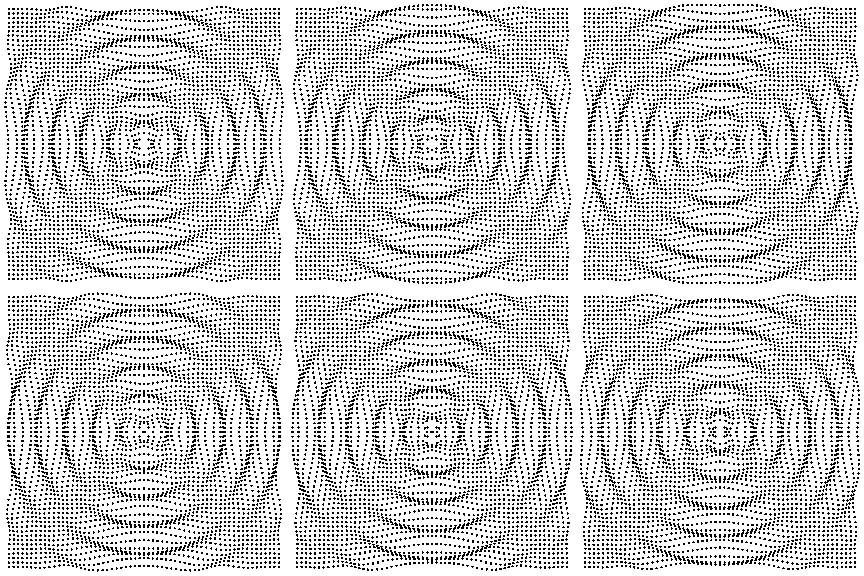
Figure. Quadrupole source radiation pattern.
🧪 Interactive Examples
Advanced Acoustic Source Simulator
📝 Key Takeaways
- A monopole source is simplest acoustic radiator, characterized by a time-varying volume flow
It radiates spherical waves with pressure: . - A dipole source consists of two out-of-phase monopoles close together. Its radiation pattern is figure-8, strongly directional, and pressure decays as .
- A quadrupole source is formed from two dipoles and produces a four-lobe radiation pattern.
It appears naturally in turbulence and high-speed flows. - Directivity increases from monopole → dipole → quadrupole, meaning higher-order sources radiate less energy forward and more in structured spatial patterns. Higher-order sources also roll off faster at low frequencies, making monopoles efficient for bass sound reproduction and quadrupoles inefficient.
- For harmonic (sinusoidal) sources, pressure fields scale with frequency, distance, radiation order, and medium impedance.
- Moving farther away from the source always increases the spherical spreading loss, where sound pressure ∝ in the far field.
🧠 Quick Quiz
1) Which of the following statements about monopole and dipole sound sources is correct?
2) The quadrupole source produces:
3) A dipole source has maximum radiation at which angle?
4) Why are monopoles efficient at radiating low frequencies?
5) Increasing the distance between listener and a monopole source: